
The Desolation of Leibowitz
Estimated reading time: 9 minutes (1787 words)
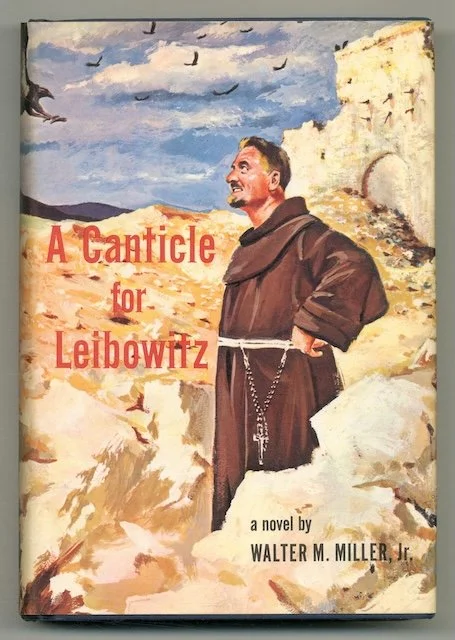
A Canticle for Leibowitz is an unlikely book to find enduring mainstream success and popularity. Part science-fiction, part post-apocalypse, and shot-through with Roman Catholicism, it combines otherwise unrelated themes into a cohesive and unique midcentury work of fiction. Among other topics, the novel raises serious questions about trust in technology, institutions, and religion that are even more salient today than they were at the novel’s publication.
Canticle was written by Walter Miller, Jr. and published in 1959 as an early contribution to the golden age of science fiction. Miller himself served in World War II and participated in the bombing of Monte Cassino in 1944, which both haunted him and contributed to the development of some of the themes found in Canticle. He converted to Catholicism after the war and remained a practicing Catholic the rest of his life.
The book is split into three parts, each one set about six hundred years into the future relative to the book’s internal timeline. Part I, “Fiat Homo,” picks up in A.D. 2600 and is set among the ruins of mid-century America destroyed by nuclear war. Part II, “Fiat Lux,” takes place in A.D. 3174. Residents of the former United States operate within what is portrayed as a medieval European political situation with Native American lore included for good measure. Part III, “Fiat Voluntas Est,” is set in A.D. 3781 and most closely resembles our own time.
But Canticle is far from a typical nuclear-apocalypse tome. In Miller’s imagination, the Roman Catholic Church survives armageddon more or less intact (the Holy See relocates to the New World, however, as “Old Rome” sustained a direct hit in the “Flame Deluge”). As the Church did during the real Middle Ages, monks dedicate themselves to preserving the accumulated knowledge of the civilization — our civilization — that destroyed itself in the 1960s. Only fragments of this knowledge survive, however, and the monks themselves don’t always understand the information they are transmitting.
The book follows one monastic order in particular, the fictional “Albertian Order of Leibowitz,” which takes its name from a mid-century scientist who survived the Flame Deluge and dedicated himself to the preservation of knowledge in the face of “simpletons” who, in an act of retribution against those who precipitated the war, destroyed books and other forms of knowledge. Leibowitz established an abbey in the New Mexico desert, and it is at this abbey that the bulk of the story takes place.
Catholic readers will immediately feel comfortable with Miller’s sympathetic depiction of the Church and monastic life. Despite the world bombing itself back to antiquity, the Church’s hierarchy re-asserts itself. The unbroken line of popes is perhaps disrupted for a time, but is never seriously threatened. The Vatican’s original archives might have been destroyed during the war, but Miller depicts the Church’s accumulated teachings, from encyclicals to papal bulls to ex cathedra statements, as intact. Even the canonization process remains the same. The only issue the Church seems to encounter is some difficulty navigating vast wastelands and roving bands of mutants or stateless marauders that are actively hostile to pilgrims or clergy.
The world portrayed in Canticle is well constructed and offers readers many interesting angles and imagination fodder, whether nuclear, Catholic, or on the nature of history itself. Alongside religious institutions, the sciences and technology are utterly fractured, then rebuilt piecemeal and finally restored. One of the central questions is posed near the end of the novel, when the world is once again on the brink of annihilation: are we, as one character asks with exasperation, doomed to repeat ourselves?
Miller seems to answer in the affirmative. Whether his conception of mankind as a species fated to continually destroy itself was written as a meditation or a warning is difficult to parse. But in Canticle’s subtext looms one theme that is impossible to escape: desolation.
For the bulk of the novel, North America is physically desolate in the aftermath and slow rebuilding from a global nuclear war. The Vatican relocates to St. Louis, but between the Holy See and the Leibowitzian Abbey in New Mexico is the wasteland of the Great Plains. No political states take root there and it is filled with bandits, mutants, and stateless tribes. Land crossings to the Vatican are treacherous and are rarely undertaken.
Then there is the Abbey itself, which is located next to Leibowitz’s fallout shelter. Discovered by one of the Abbey’s monks, relics and papers found in the shelter (as well as the skull of Leibowitz’s wife) pave the way for two canonizations later in the novel. Despite these sideplots, however, Miller makes clear that the world’s desolation is total. As one character aptly observes, the ruins of a great civilization abound. It is up to them, the future generations, to piece together what happened and reclaim the knowledge that was destroyed along with everything else.
The novel’s descriptions of physical desolation make for an imaginative setting. But the through-line of spiritual desolation animates everything else. How could it not? The world was annihilated, and out of the ashes arose weaponized ignorance, cruelty, and literal paganism. All of the book's characters, Catholic or not, are forced to navigate a moral landscape that resembles pagan Rome, but with significantly more radioactive fallout. The war seems to have destroyed religion and society in equal parts.
A close reading of Canticle illuminates Miller’s exploration of theological hope, or lack thereof. The existence of hope is woven tightly through all three chapters, but it is also curiously absent as the characters interact with the world around them. Nothing humanity builds lasts forever, and we can do profound damage to the natural world, yet the indestructible possibility of hope somehow seems to remain.
There exists a tension that is difficult to rectify: the monks “await the blessed hope, the coming of our savior, Jesus Christ,” but deliverance never actually comes. In the end, a small contingent of monks are forced to take their mission to the stars while their brothers on earth are vaporized again. Two thousand years after the world’s first destruction, and four thousand years from the birth of Christ, the order carries on, waiting for the finality of the Second Coming.
Divine intervention in human affairs is a given in Christianity, from the Old Testament to the Incarnation and beyond. Thus, a God who permits not one but two global holocausts would, one would think, at some point, pull the world out of its despair. But He never does. Divine inaction — indeed, there is not even a hint of the eschaton — at this scale is an unsettling possibility to consider. (Remove the nuclear holocaust, however, and Miller is describing the Twentieth Century).
What to make of all this? As a friend observed, on the seventh day God rested, removing Himself from Creation. The Creator taking a step back from, or a step out of, history does not need to conflict with an interventionist understanding of providence. God can and does directly influence history — consider miracles, visions, and of course the Incarnation — or he can let events take their course as He does in Miller’s telling.
The God portrayed in Canticle is both remote and exactingly just. The monks and the Church pray unceasingly throughout the ages, but it seems their prayers reach deaf ears. God’s presence is never demonstrated. Even the Eucharist, while present in the book, is not a main character and is referenced sparingly.
Here Canticle scholars might find a source of disagreement. The book’s third act introduces Mrs. Grales/Rachel, an enigmatic Tom Bombadil-type character. She has one human head and one smaller head, joined at the neck; her smaller head is nonresponsive to stimuli and is speculated in-novel to either be a birth defect or mutation.
She appears at the Abbey’s gates and (here comes a major spoiler) appears transfigured in the immediate aftermath of the nuclear war that concludes the novel. Her reanimated smaller head refuses baptism and distributes the Eucharist to the abbey’s superior who is trapped and dying beneath the rubble. But Miller leaves her character there without any further explanation. Whoever she is, she brings bread from heaven to a desperate, ravaged community.
Rachel’s appearance is confusing, but readers usually break into two camps regarding her symbolism: she is either a personification of the Church, or a sort of Marian figure.
Rachel’s transfiguration could symbolize the Church’s inevitable survival throughout the ages. The world may be destroyed (again) but the Church continues, much like it did throughout the Twentieth Century. Indeed, even in the novel’s dark ending, the Church relocates to Earth’s colonies scattered throughout the solar system. Rachel also comes into focus as a Marian figure. The fact that Rachel is not created, per se, parallels Mary’s immaculate conception, a point driven home by her refusal to be baptised and her distribution of the Eucharist.
Both interpretations are valid because both are underscored by the theological virtue of hope (as Saint Paul lists in 1 Corinthians, along with faith and charity). In day-to-day use, and indeed, how some of the characters the reader meets in Canticle probably think, “hope” is less a virtue and more of a verb: to hope for a better, less nuclear world but without the expectation that it will necessarily happen. In your own life, how often do you say “I hope so” as a fifty-fifty proposition with the assumption that nothing will happen?
But as Saint Paul’s list hints at, hope is more than an optimistic/pessimistic dichotomy. Theological hope, as Catholics understand it, is “the desire of something together with the expectation of obtaining it,” to quote the Catholic Encyclopedia. This is usually applied to salvation: we desire it and expect to obtain it through divine assistance, such as grace and the sacraments.
This is why Rachel can take on multiple interpretations. As the institutional church, she represents the vessel through which the sacraments are accessed. And as a Marian figure, she represents the physical vessel, Mary, that bore the Redeemer.
In either case, Rachel is clearly some kind of heavenly symbol, but of all the novel’s characters, she is the most confounding. At minimum, she represents Miller’s way of inserting something mystical within an otherwise barren world.
The world Miller constructed is, like our own, colored by the Divine. The unbroken existence of the Roman Church is testimony to that. Digressions throughout the novel make clear that beauty and human dignity, though twisted by fallout and radiation, have not been jettisoned. As in the Twentieth Century, when Miller was an active participant in history’s worst war, God’s presence is felt more in civilization’s ruins than in any civilizational triumph. His presence, although subtle, endures forever.